

The Critical Mineral & Rare Earth Crunch
Key Takeaways
- AI, energy, and defense all compete for the same finite materials, and none are slowing down.
- Rare earths aren't scarce; processing is the real chokepoint, and China controls it.
- Mines and refineries are too slow for venture. Speed and de-risking are the real plays.
- Software is wide open, with no category leader yet in compliance, pricing, or permitting.
Section I: The Demand Shock and the Supply Constraint
The Part of the AI Story Nobody Models
Every AI buildout pitch models the compute, the power, and the capital. Almost none of them model the mineral bill of materials underneath it all, as if the turbines and transformers just show up assembled.
They don't, of course, and the reason they don't is the subject of this paper.
In How to Make Hardware Venture-Shaped, we argued that the strongest position in hardware is the chokepoint supplier: one of very few qualified providers of a scarce input that everyone downstream urgently needs. Critical minerals are that idea at the scale of the entire industrial economy. Rare earth magnets, gallium, copper—the boring, scarce inputs nobody notices until they're the reason a $100B buildout can't ship. Right now the qualified supplier for most of the chain is a single country, and it has started saying no.
This deep dive does three things. First it lays out why demand is outrunning supply and why the market can't just fix it on its own. Then it maps who is building across the supply chain, from AI prospecting to magnet recycling, and where the gaps are. The last section is the part we care most about: a framework for which of these companies are actually venture-shaped. Most of them, including some of the good ones, are not.
A note on scope. The same structural pattern—concentrated processing, long supply timelines, accelerating demand—holds across copper, gallium, and cobalt. We use magnet rare earths as the through-line because the constraint is sharpest there, but the framework generalizes.
Three Demand Cycles, One Supply Chain
Rare earths are a family of 17 metallic elements with unusual magnetic and electronic properties that make them essential for things like semiconductors, sensors, and defense systems. They sit inside products most people never associate with mining, from data center cooling equipment and EV motors to satellites and precision weapons.
That matters now because three enormous demand cycles are accelerating at the same time. AI infrastructure, the energy transition, and Western defense modernization are all pulling on rare earth elements, copper, gallium, and a handful of other inputs that sit underneath modern industrial systems. None is slowing down to make room for the others, so the mineral constraint increasingly sets the ceiling on how fast each can move.
Some numbers. Goldman Sachs projects global data center power demand rising 165% by 2030 against a 2023 baseline, and every megawatt of new capacity carries a physical bill of materials: copper for power delivery, magnet material for thermal management, compound semiconductors for the chips. The IEA attributes an incremental 11% increase in global gallium demand, 3% in rare earths, and 2% in copper to AI data centers alone by 2030—on top of a base case that was already strained. Demand for magnet rare earths has doubled since 2015 and was projected to rise more than 30% further by 2030 before the full scale of the AI buildout was priced in.
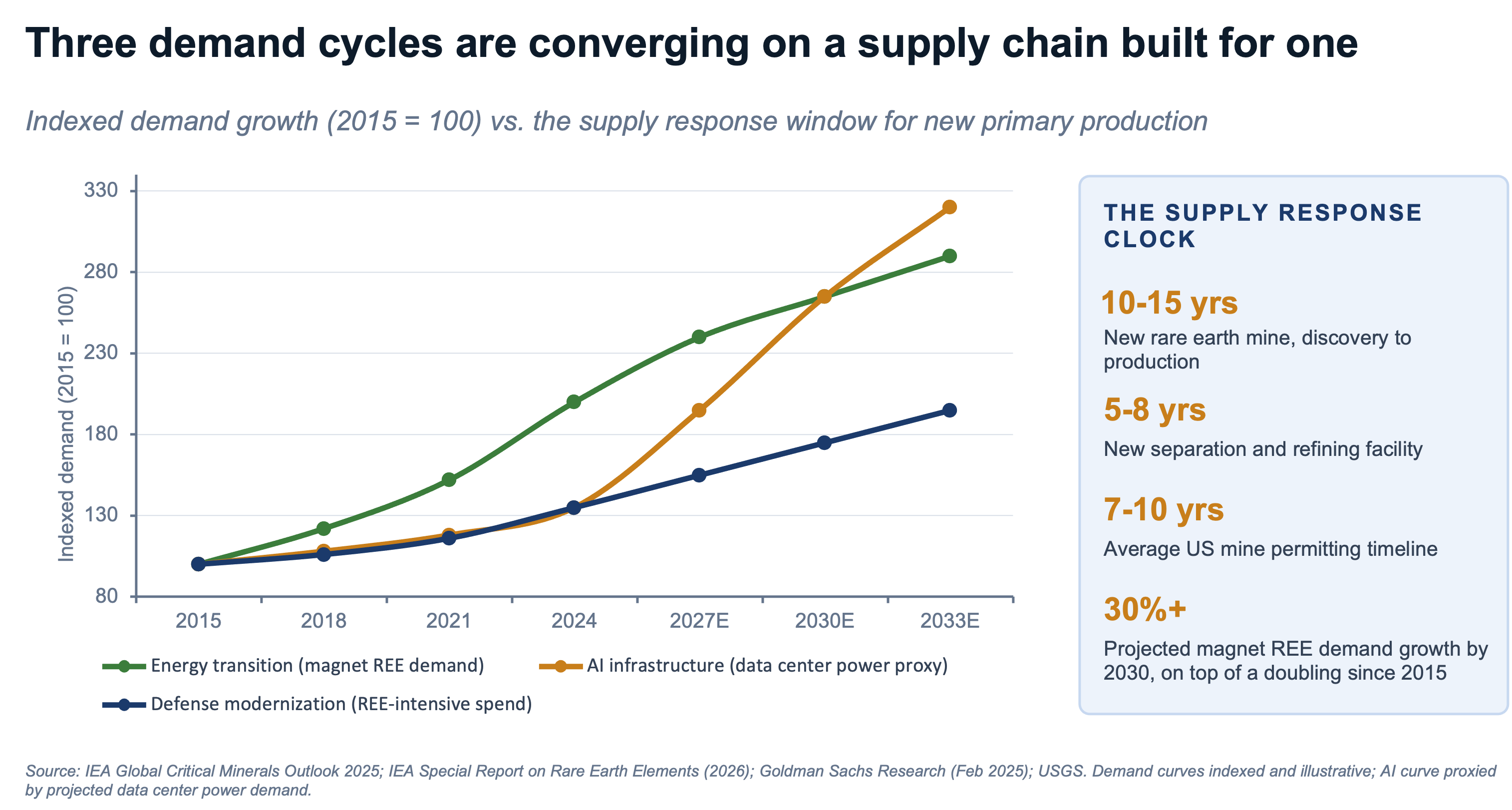
Two things stand out in this chart. The AI infrastructure line starts later and climbs faster than the other two. And every curve is outrunning the box on the right: a new rare earth mine takes ten to fifteen years from discovery to production, longer than any of these projections take to hit 2030. The demand curves are a sprint. The supply response is not.
The physical terms make the scale concrete. An EV motor carries one to three kilograms of neodymium-iron-boron magnets. An offshore wind turbine carries roughly 600. An F-35, an estimated 417. None of that is AI's demand, nor is it going away any time soon. US defense spending above $900 billion annually is shifting toward precision-guided, electronics-heavy systems that need these materials by design.
Why the Market Cannot Simply Respond
The natural objection: if demand for rare earths is spiking, why doesn't the market just mine more?
Because rare earths are, well, not actually that rare. The problem is that they rarely occur in large enough concentrations, and are notoriously difficult to separate into usable materials.
Mining more does not solve the real bottleneck, which is converting ore into high-purity, individually separated oxides and metals that manufacturers can actually use. That process is complex, environmentally messy, and expensive to replicate. And most importantly, the capacity to do it is concentrated in one place.
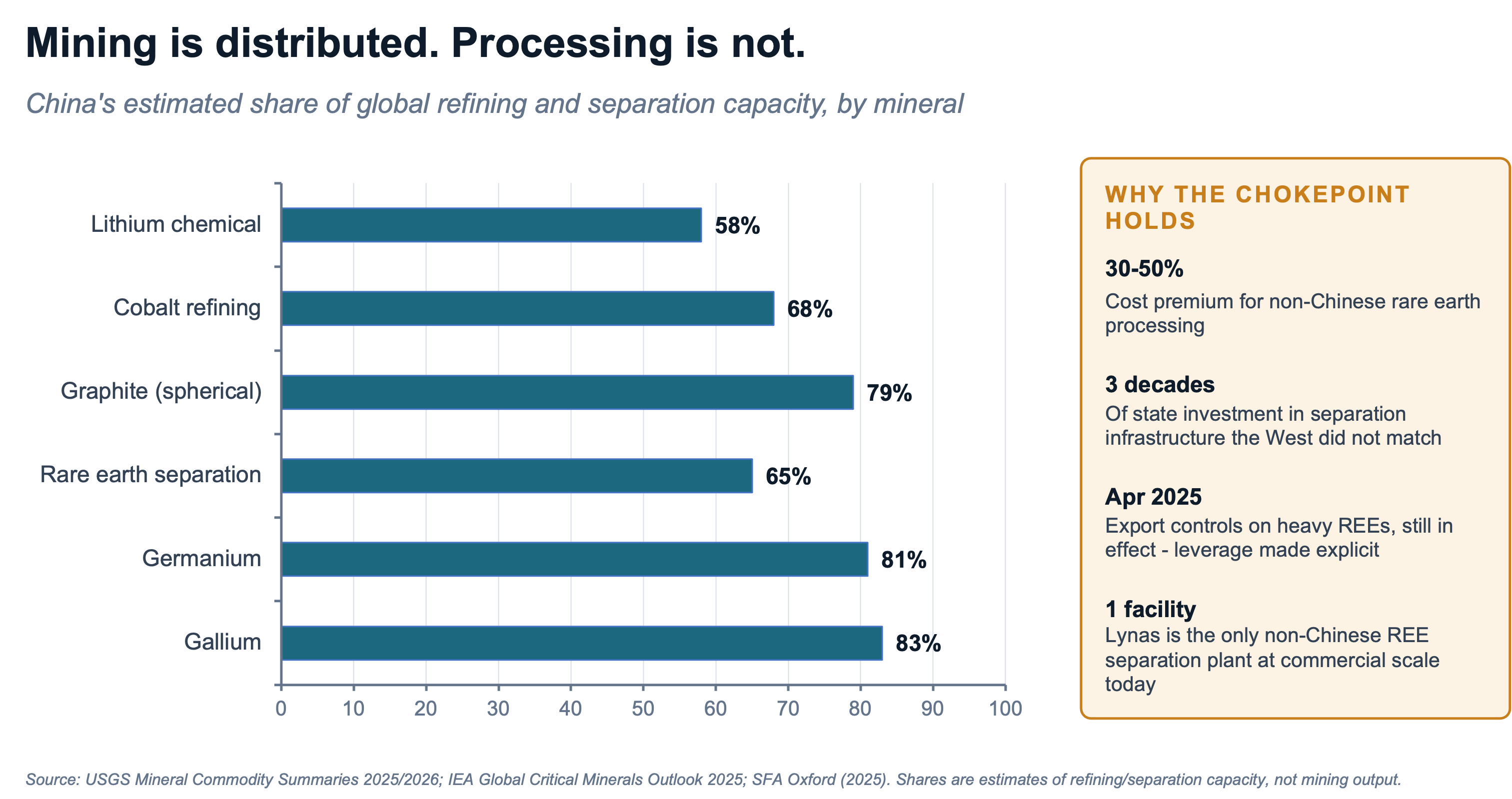
China did not luck its way into dominating rare earth processing. It built that position deliberately over three decades, while Western producers had little economic incentive to compete. Today, China controls roughly 60–70% of global rare earth separation capacity, with its share rising above 80% for gallium and germanium refining. Lynas remains the only significant non-Chinese rare earth separation facility operating at commercial scale, leaving the rest of the world with remarkably little alternative capacity.
And China has also shown willingness to use that position. Export controls introduced in April 2025 targeted heavy rare earths used in defense applications. A broader escalation followed in October, including extraterritorial licensing provisions, before some measures were partially suspended in November. The April controls remain in effect. Whatever "supply risk" meant to Western buyers before that episode, it means something more concrete now.
The same history helps explain why Western processing remains 30–50% more expensive. Three decades of accumulated Chinese scale and infrastructure is a financing and policy problem as much as an engineering one, and private capital alone won't close it. On the conventional path, the supply response to today's demand surge arrives 2035–2040 at the earliest.
One more number before the market map: less than 5% of rare earth elements get recycled globally. The secondary supply that should be cushioning this shortage barely exists yet. Keep that in your back pocket—it's the reason recycling gets its own category below.
Section II: The Critical Mineral Stack
The Critical Minerals Stack
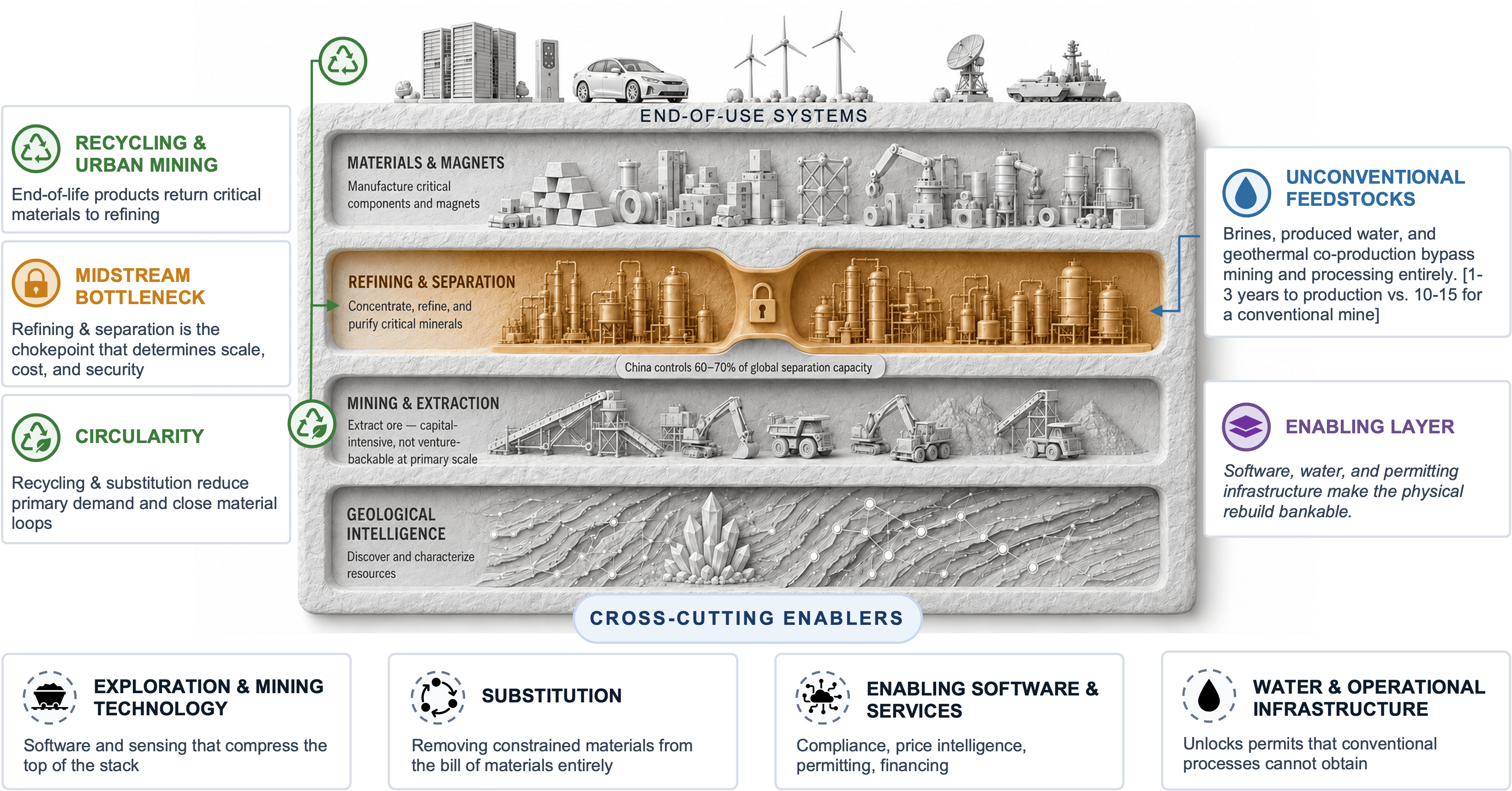
The supply chain looks simple on paper: extract, process, manufacture, ship. In practice it's one of the most geographically concentrated and capital-intensive industrial systems in the global economy, built to serve one large demand driver at a time (and now being asked to serve three). The map below shows who is building within it, where incumbents are too large or too government-dependent for venture engagement, and where the gaps are. Those gaps are the structural consequence of thirty years of Western underinvestment, now colliding with the demand curves above.
How To Read This Map
Read the stack bottom to top, the way the material moves: geological intelligence finds resources, mining extracts them, refining and separation purifies them, and materials and magnets turn them into usable components.
Around that physical stack sit the cross-cutting pathways and infrastructure explored below: recycling, substitution, unconventional feedstocks, software, water, and operational technology.
For publication we consolidated that structure into eight investable categories:
* Noveon and Vulcan illustrate that scale-up is happening, not typical seed or Series A entry points. See Materials and Magnets, Section 2.2.
The Physical Supply Chain
Exploration and Mining Technology
Finding and operating mines has historically meant years of exploratory drilling and scarce field expertise. KoBold Metals uses machine learning to identify high-probability deposits before drilling, while Ideon Technologies uses cosmic-ray muon tomography to map resources without drilling at all. Similar tools are emerging around mine autonomy and operational optimization.
What is missing from this list is mines themselves. Primary mining requires hundreds of millions in pre-production capex, decade-plus timelines, and stacked geological and permitting risk. The venture opportunity is in changing the economics of finding and operating mines without taking the mining risk directly.
Processing and Separation—The Chokepoint
Converting ore into high-purity separated oxides and metals is the step China spent thirty years building infrastructure to dominate, and it's where the Western gap is widest.
What's venture-backable here is technology that attacks the 30–50% cost premium from a novel direction. For example, BlueShift is developing electrochemical extraction from mine tailings and coal fly ash, avoiding conventional solvent extraction chemistry entirely. Blue Ore Metals is building domestic rare earth refining designed around magnet waste as feedstock—closing the loop between recycling and refining, and starting from material that's already partially concentrated
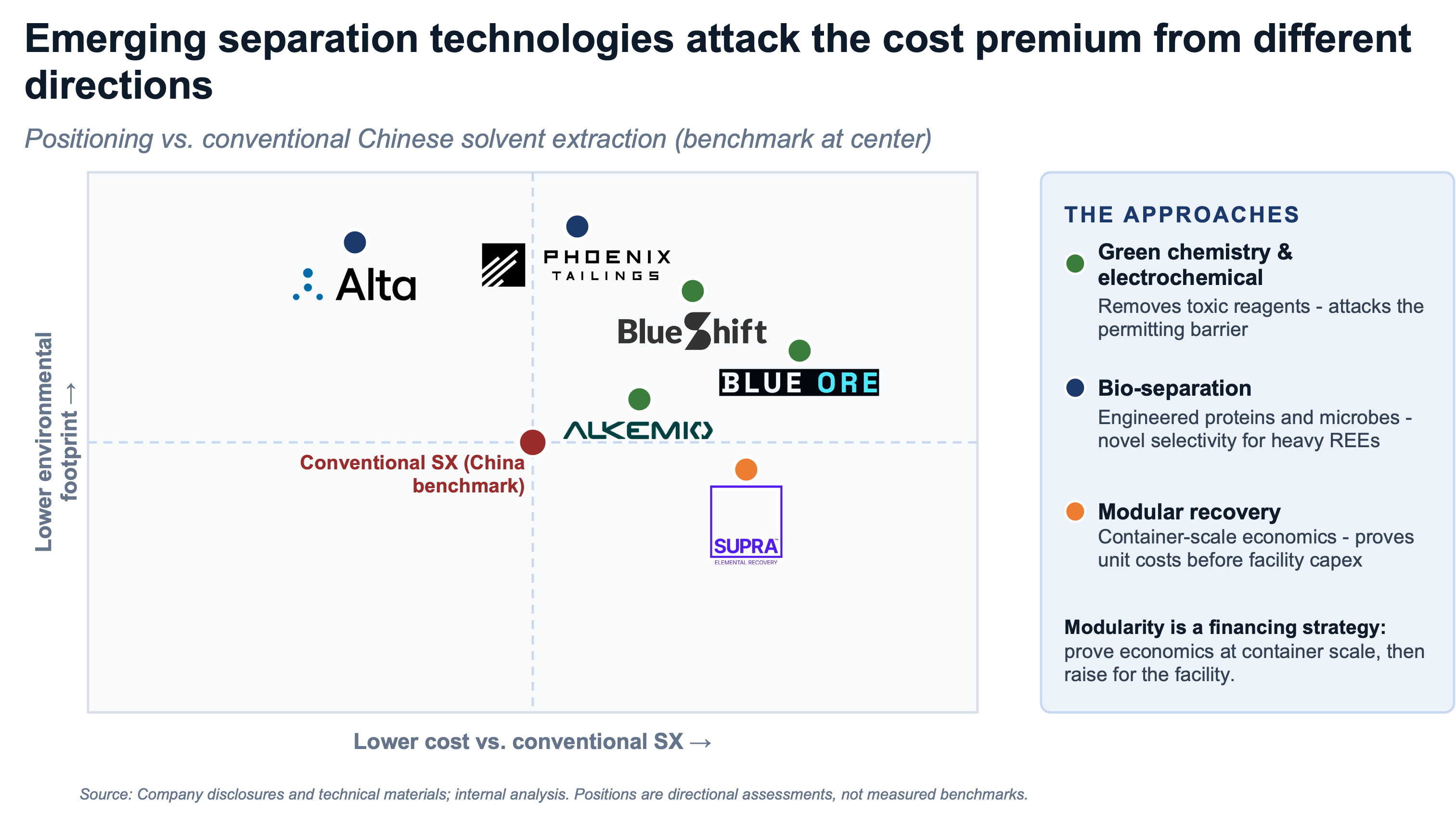
Nearly every company is trying to beat the Chinese benchmark on cost, environmental footprint, or both. Modularity is as much a financing strategy as an engineering choice: proving economics at container scale can unlock venture capital, government co-investment, and offtake before a full facility is built.
Materials and Magnets
Processing more rare earths does not solve the supply-chain problem on its own. Separated materials still have to become magnets that meet exact requirements for strength, heat tolerance, reliability, and consistency—a qualification process that can take years.
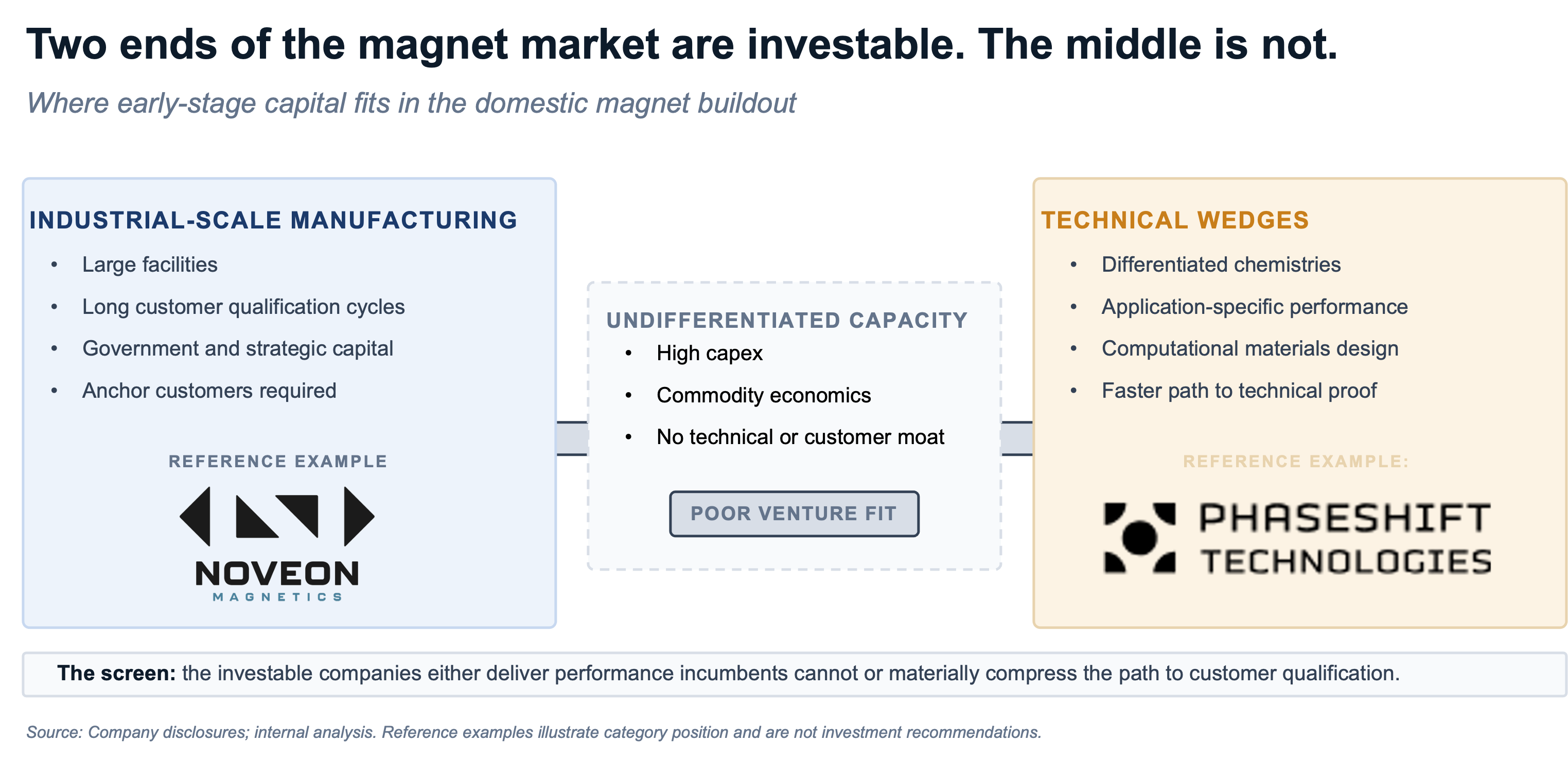
That creates a barbell-shaped opportunity. At one end, industrial-scale manufacturing requires large facilities, government support, and anchor customers. Noveon Magnetics illustrates the model: meaningful domestic production, but at a scale and capital requirement beyond a typical early-stage investment. At the other are venture-scale technical wedges such as differentiated chemistries and computational tools; Phaseshift uses AI-driven alloy design to reduce physical iteration.
The unattractive middle is undifferentiated manufacturing capacity. The investable companies either deliver performance incumbents cannot or materially compress the path to customer qualification.
The Cross-Cutting Layers
Recycling, substitution, and unconventional feedstocks all offer ways to pull supply forward without waiting ten to fifteen years for a new mine. But none is automatically faster, cheaper, or more scalable. Each avoids one bottleneck while introducing another: feedstock control in recycling, performance and qualification in substitution, and resource economics in unconventional extraction.
Recycling and Urban Mining
Remember the number from earlier: less than 5% of rare earths get recycled globally. The constraint is not just recovery technology. Mixed electronics and end-of-life motors require sorting, dismantling, and chemical processing that can recreate many of the costs recycling is meant to avoid. The opportunity improves as every EV adds magnet material to the future urban mine, but the strongest companies will control a predictable feedstock stream and design their process around it. Cyclic Materials and HyProMag illustrate the two essential pieces: collection at scale and lower-energy recovery.
Substitution
Substitution asks a more radical question: how do you remove the constrained material from the bill of materials entirely?
In some applications, the answer is already yes, in some motors and lower-performance applications; the harder problem is replacing NdFeB where power density, heat tolerance, and reliability matter.
Iron-nitride magnets are the most credible attempt to close that gap. Niron Magnetics has reached customer sampling and is building commercial capacity, while companies such as MatNex are still working at the material-discovery stage. The opportunity is application-specific: start where rare-earth-free performance is sufficient, then move into more demanding markets.
Unconventional Feedstocks
A third group skips the conventional mine altogether. Geothermal brines, oilfield produced water, and industrial waste streams contain critical minerals that can be recovered without surface mining. But finding minerals in a waste stream is not the same as extracting them economically. Concentration, variable chemistry, fouling, and separation costs can overwhelm the value of the recovered material.
The strongest models rely on co-product economics—using existing infrastructure or combining recovery with energy production, water treatment, or avoided disposal costs. Element3 and Hades Mining illustrate the model, although the thesis is currently stronger for lithium and select minerals than for magnet rare earths.
Recycling, substitution, and unconventional feedstocks are different mechanisms aimed at the same target: pulling supply forward in time. The chart below puts them side by side against the conventional mine baseline.
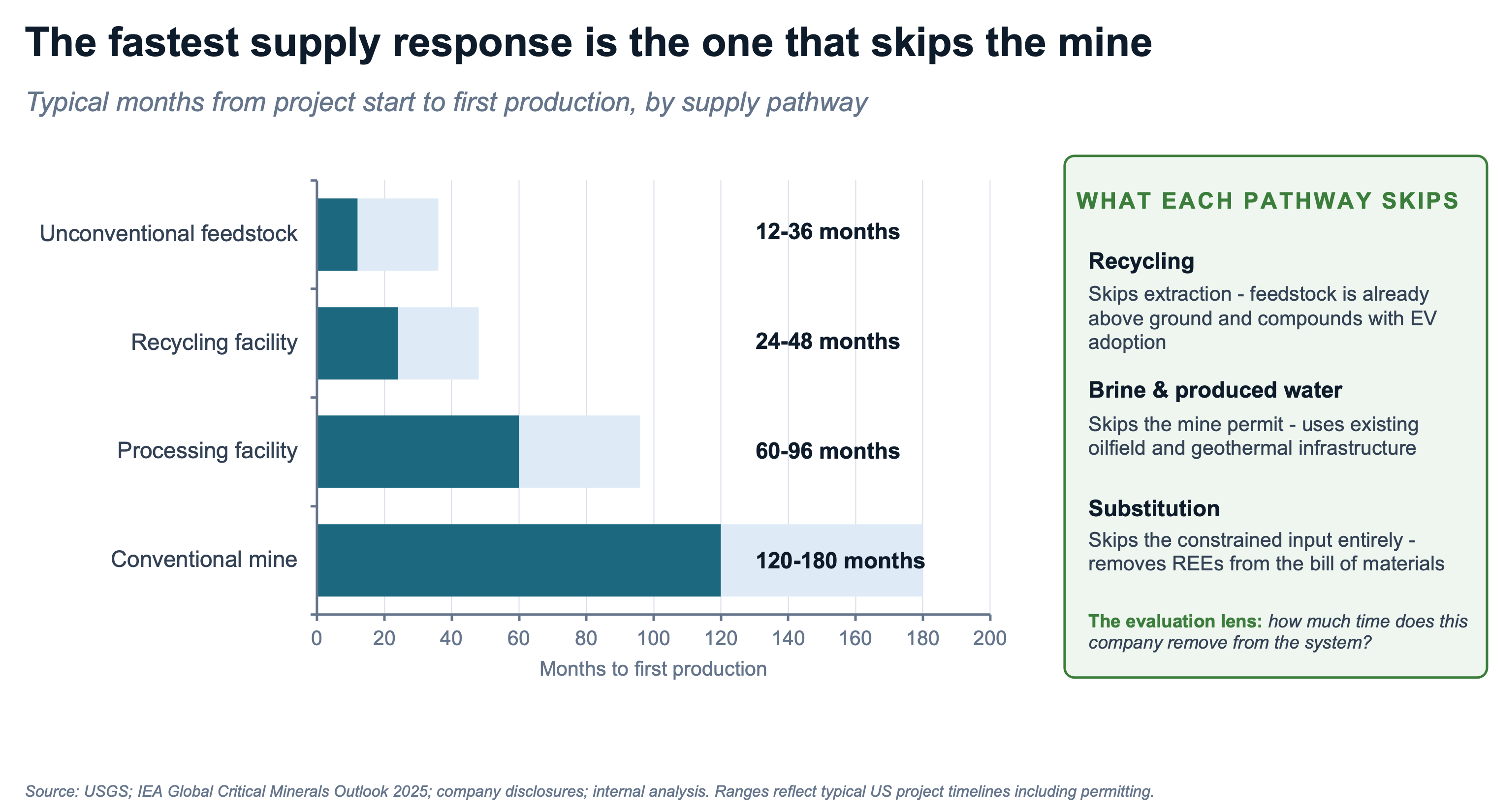
None of these pathways replaces primary mining at the volumes ultimately required. Their value is speed: they can contribute supply or reduce demand while the conventional mine-based response remains years away.
The Missing Software Layer
The physical supply chain is being rebuilt with tens of billions in public and private capital. The information layer around it has not kept pace.
New supply has to be traced, priced, contracted, permitted, and financed before it becomes usable. Yet no category-defining platform has emerged across three critical workflows:
- Provenance and compliance. Manufacturers increasingly have to document where critical minerals were mined and processed to qualify for IRA incentives and meet EU requirements. CommonShare and Circularise are building pieces of the traceability stack, but neither is purpose-built around the full critical minerals workflow.
- Price intelligence. Rare earth pricing remains opaque and broker-quoted, with no liquid exchange equivalent to those for copper or aluminum. Commodity publishers provide assessments, but producers, buyers, and lenders still lack the forward curves and demand visibility required to confidently structure long-term contracts.
- Permitting and financing. Mine and processing projects must coordinate years of environmental documentation, agency review, government funding, and private capital. Nyxium is building siting and permitting software, while companies such as Ridgeline Royalties are adapting financing models from precious metals. The category remains fragmented despite the value of pulling even months out of a project timeline.
The opportunity may not be one system that does everything. More likely, category leaders emerge within each workflow and become embedded infrastructure for the manufacturers, project developers, lenders, and government agencies rebuilding the supply chain.
Water and Operational Infrastructure
Water is the permitting bottleneck the mineral chemistry conversation usually skips. A mine or processing facility that can't secure water rights, treat what it discharges, or handle tailings without a dam doesn't get built, no matter how good the separation technology is.
Companies including MaverickX, Somerset International, and Watercycle Technologies are attacking pieces of that physical infrastructure, but this is a more project-specific and services-heavy opportunity than the software categories above.
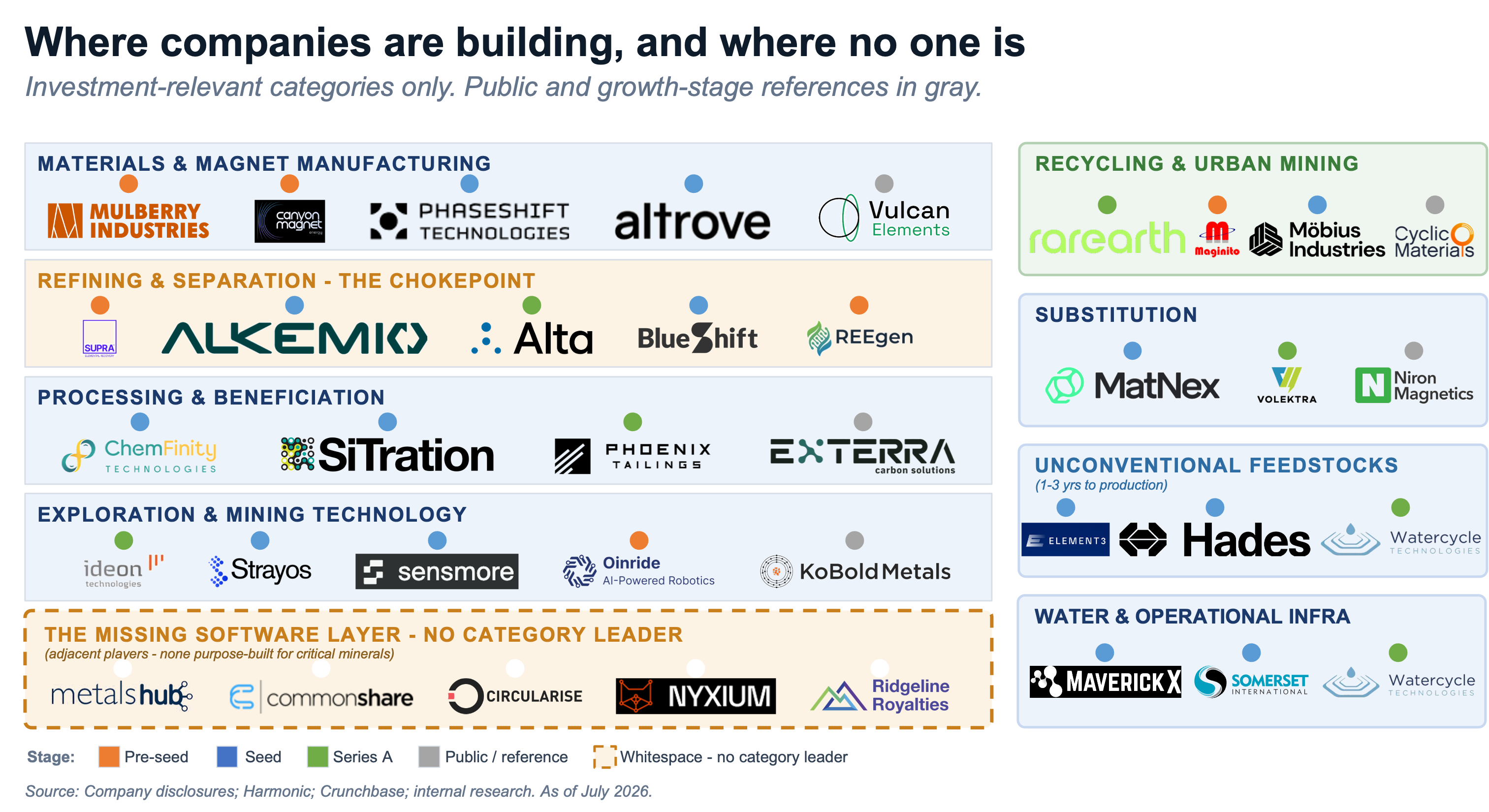
The map makes the imbalance visible. Recycling and unconventional feedstocks have attracted a growing seed and Series A cohort, while processing and separation remain technically active but largely pre-scale. The software layer is the least developed relative to the amount of capital and coordination the broader rebuild will require.
That missing layer is one of the clearest venture opportunities in the stack.
Section III: Where Investors Should Be Looking
Look at the map above and the instinct is obvious: fund supply. More mines, more refineries, more magnet plants. For venture capital, that instinct is mostly wrong. The better opportunity lies in the companies that make new supply possible on a venture timeline.
The graph below shows why. Some categories are conventional venture businesses; others are strategic infrastructure that venture can only support at the margins. The most interesting physical opportunities sit between them: companies that can reach proof on a venture timeline, then use that proof to unlock a cheaper pool of capital.
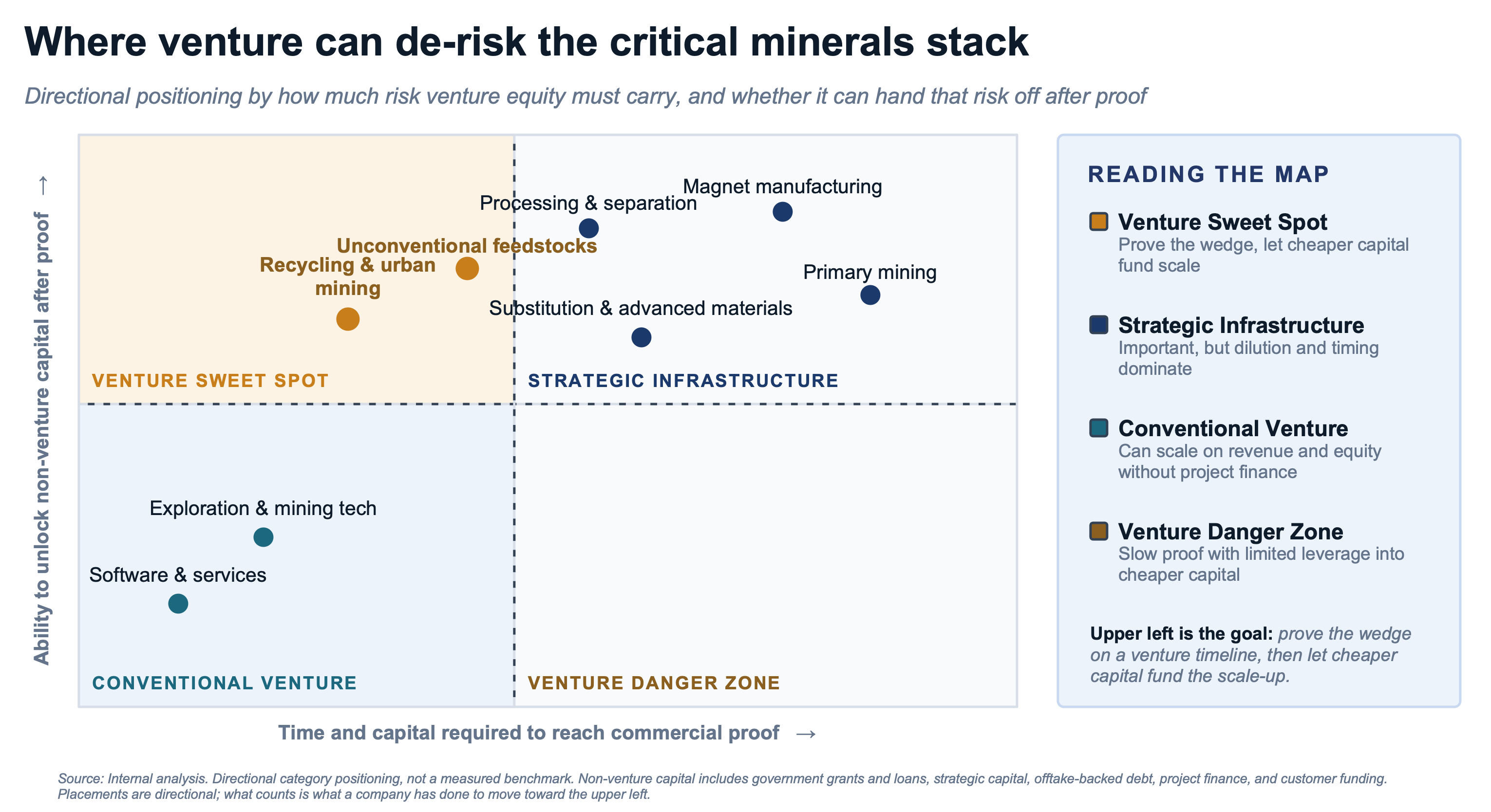
The horizontal axis shows how much time and venture capital a company must absorb before reaching commercial proof. The vertical axis shows whether that proof can unlock cheaper capital—government funding, strategic investment, customer commitments, debt, or project finance. Put differently, the x-axis is how much risk equity has to carry; the y-axis is whether it can eventually hand that risk off.
That creates two viable venture shapes. Asset-light businesses can scale through conventional venture economics without project capital. The most interesting physical opportunities sit above them: companies that can reach proof on a venture timeline, then use that proof to unlock a much larger pool of cheaper capital. Further right, the underwriting gets harder as years of development, qualification, and equity exposure accumulate.
The placements are directional, not fixed. The real question is not simply which category a company occupies, but what it has done to move toward the upper-left.
The Obvious Gap Is Supply. The Investable Gap Is Bankability.
The Western world does not lack ore bodies, processing patents, or engineering talent. What it lacks is projects that can get financed, permitted, qualified, and contracted on timelines that matter.
A separation technology that works in a lab is not yet a supply solution. The company still has to secure feedstock, prove yields at scale, qualify its output with customers, sign offtake, obtain permits, and assemble the capital required to build. Most projects fail somewhere between technical validation and commercial bankability.
That gap is where venture can matter: proving process economics at modular scale, compressing permitting and qualification timelines, creating price transparency, and building the compliance and contracting infrastructure that lets customers commit to new Western supply.
The Best Startups Compress Time and Unlock the Next Dollar
In How to Make Hardware Venture-Shaped, we argued that two questions do most of the work: where is the recurring or chokepoint layer, and who funds the capex? Both apply here. Critical minerals add a third: how much time does the company remove from the system?
Every layer of this market is governed by a clock. The companies worth backing either remove a step or materially shorten it: recycling skips extraction, unconventional feedstocks use existing infrastructure, substitution removes the constrained input, and software accelerates permitting, compliance, and contracting.
However, the more important question is what the company unlocks next. The best businesses use venture capital to reach a milestone that attracts cheaper and more patient capital. In other words, the venture case depends on whether each dollar invested retires enough technical, commercial, or regulatory risk for the next pool of capital to step in.
Underwrite the Bottleneck, Not Just the Technology
Four questions matter across nearly every company on the map:
- Does it control the feedstock, resource, or customer relationship it depends on?
- Is there a credible path to customer qualification and contracted demand?
- Can the company reach commercial proof before requiring infrastructure-scale capital?
- Does the moat extend beyond the core chemistry into process know-how, data, permits, supply agreements, or customer integration?
A technically impressive process without feedstock control or an end market is not a company. Nor is a manufacturing facility whose only advantage is being domestic. The investable businesses own a specific chokepoint and become harder to replace as they move through qualification and scale.
The Team Has to Span the Track
Technical depth alone is not enough in this market, and neither is a conventional SaaS playbook. The strongest founders have lived inside the problem and can translate across the lab, the plant, the customer, the regulator, and the capital provider.
They know which technical milestone will unlock customer qualification, which buyer is most likely to move first, and which pool of capital should fund each stage. A domain expert without commercial fluency risks building a science project; a generalist without domain depth risks underestimating qualification cycles, capex, and policy dependence.
The founders worth backing can sequence technical proof, customer pull, permitting, and non-dilutive capital into a credible path to scale. Geography matters only insofar as it creates that proximity—whether to processing infrastructure, strategic customers, or government programs.
What the Winning Companies Will Look Like
Our view: the next generation of critical minerals companies will rarely look like traditional mining companies, but they will not look like pure software companies either. They will be hybrids: part industrial process, part software system, part supply-chain finance, and part regulatory navigation.
Take a magnet recycler. On paper it's an industrial processing business. But the process is the entry ticket, not the moat, as what actually compounds is everything around it: the feedstock contracts locked up, the qualification data, the compliance record. Ripping that company out of a supply chain means re-signing, re-qualifying, and re-documenting, and nobody downstream wants to spend eighteen months doing that.
The hybrid shape matters because none of these companies can depend on rare earth prices staying high or geopolitical urgency lasting forever. Scarcity attracts new capacity, and eventually the market responds. A venture-scale company has to become more valuable as that response arrives—which means owning a step the new supply chain cannot easily bypass: a qualified process, a trusted source of feedstock, a customer relationship that took years to earn, or infrastructure every new project needs.
That is the difference between a commodity bet and a venture bet. The supply crunch is structural, but venture does not have to rebuild the entire supply chain—it has to back the companies that control its most valuable chokepoints. The best of them will not just benefit from the crunch. They will be essential to the supply chain built to solve it.
Appendix & Sources
The Full Taxonomy
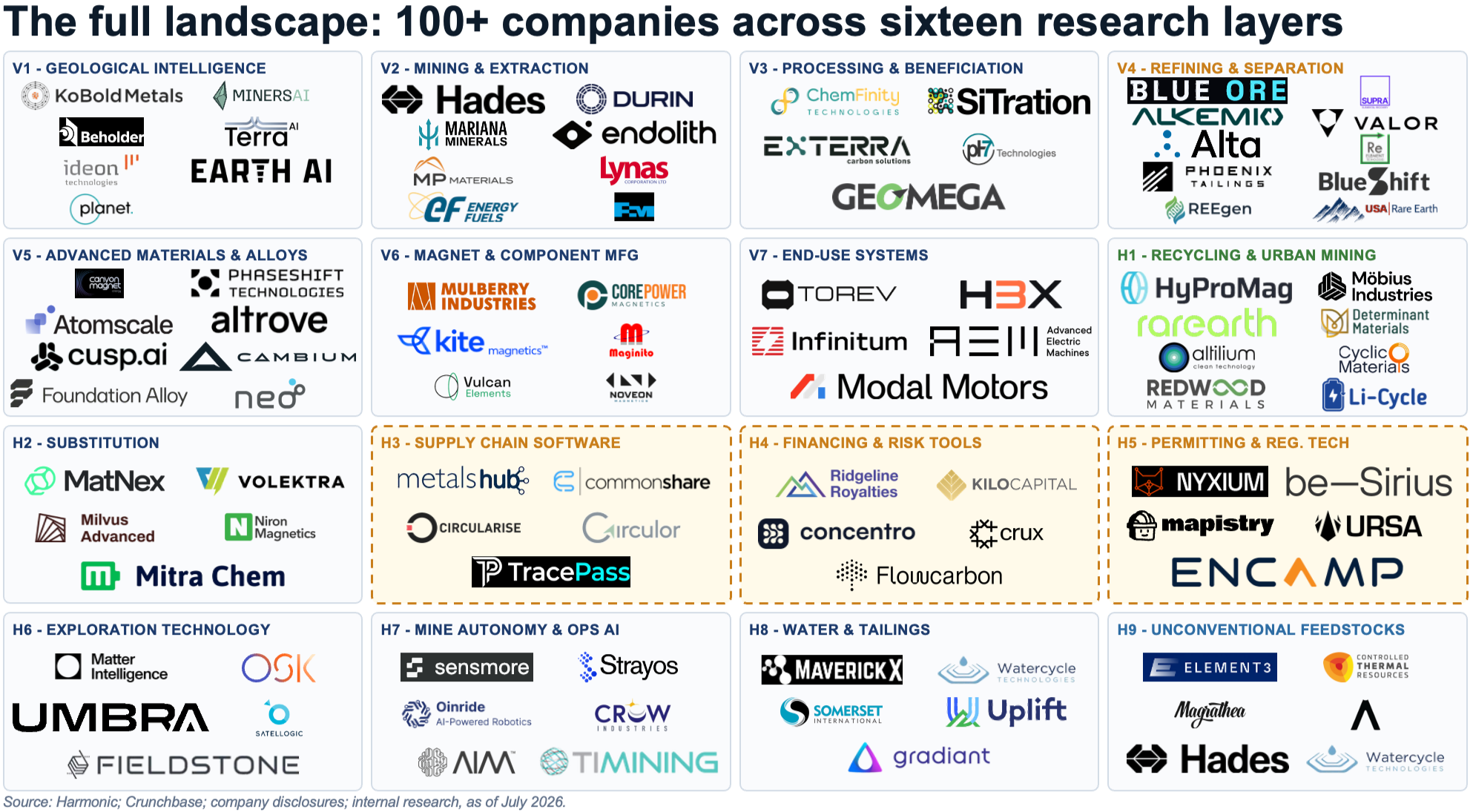
The eight publication categories in Section 2 consolidate a broader sixteen-layer research taxonomy, seven vertical layers tracing the physical supply chain and nine horizontal layers cutting across it. The full landscape mapped against this taxonomy appears in Section 4.2.
Vertical layers (the physical supply chain, ore to component):
- V1. Geological Intelligence
- V2. Mining & Extraction
- V3. Processing & Beneficiation
- V4. Refining & Separation
- V5. Advanced Materials & Alloys
- V6. Magnet & Component Manufacturing
- V7. End-Use Systems
Horizontal layers (cross-cutting the stack):
- H1. Recycling & Urban Mining
- H2. Substitution
- H3. Supply Chain Software
- H4. Financing & Risk Tools
- H5. Permitting & Regulatory Tech
- H6. Exploration Technology
- H7. Mine Autonomy & Operations
- H8. Water & Tailings
- H9. Unconventional Feedstocks
Market Map: Full Company Landscape
The full company map covers 100+ companies across sixteen research layers, identified through primary research and market data platforms. The version below demonstrates research breadth; the investment-focused map appears as Graphic 2.D in Section 2.4.
Sources
[1] USGS Mineral Commodity Summaries 2025/2026
[2] IEA Global Critical Minerals Outlook 2025
[3] IEA Energy and AI Report, April 2025
[4] Goldman Sachs Research, February 2025
[5] S&P Global
[6] Wood Mackenzie
[7] Chatham House
[8] SFA Oxford
[9] Harmonic
[10] Crunchbase
*Company press releases and investor announcements. Funding figures reflect publicly disclosed amounts as of July 2026; where totals include grants, loans, or non-dilutive government support, this is noted in the text.
written by
.png)






.png)


